
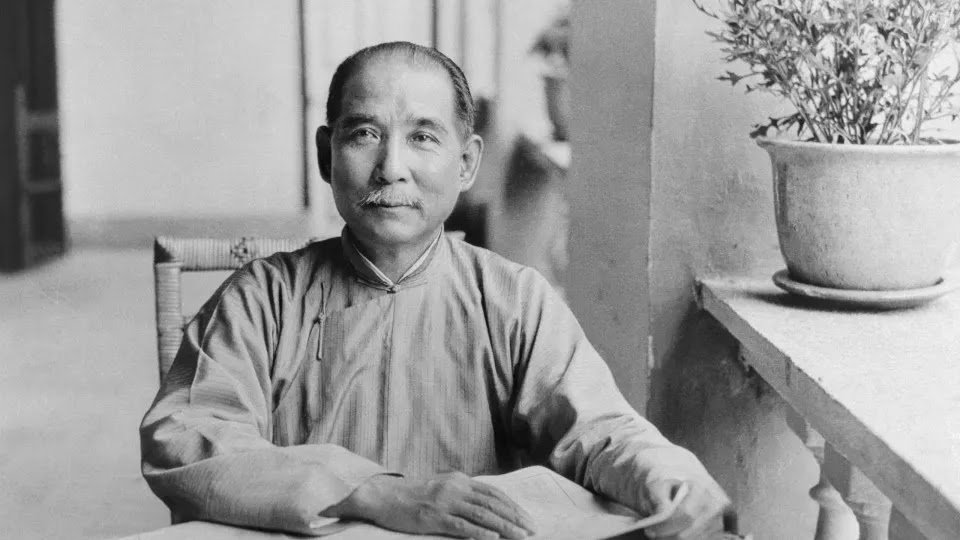

China’s first post-imperial president and considered the father of the country’s modern era, Sun Yat-sen, was remembered on the 100th anniversary of his death in mainland China and Taiwan today.
In Beijing, a “brief and solemn ceremony” was held to pay tribute to Sun at the Beijing park that bears his name. Officials and “people from all walks of life” attended, keeping silence and bowing three times in front of his statue, the official Xinhua news agency reported.
The Chinese Academy of History praised Sun on its Weibo social media account, describing him as “a great national hero, a great patriot and a great forerunner of China’s democratic revolution.”
The southeastern city of Guangzhou, capital of Sun’s native Guangdong province, on Tuesday opened an exhibition of antiques related to the man who was one of the instigators of the revolution that overthrew the Qing dynasty (1644-1911).
Sun’s memorial building in the city hosted the first performance of a musical based on the revolutionary’s youth.
The “father” of modern China was also remembered across the Taiwan Strait: representatives of the Kuomintang (KMT), Taiwan’s main opposition party, went to the Sun Yat-sen memorial in Taipei to lay flowers and pay their respects.
Among those present was KMT chairman Eric Chu, who was booed by many in attendance due to his party’s poor performance in the last three presidential elections.
Despite having founded the KMT under its current name in 1919, which would become the main rival of the Chinese Communist Party (CCP), Sun is a respected figure both by the communists in China and by the KMT in Taiwan, where he is identified as the founder of the regime that moved to the island, which still maintains the official name of the Republic of China after its defeat by the communists in the civil war (1927-1949).
The Taiwan Affairs Office of the State Council (Chinese executive) said today that Sun “sought national unity and the rejuvenation of China throughout his life”, while calling on “Taiwan compatriots to join us in inheriting his legacy” and to “oppose the secession” of the island.
Born in 1866, Sun studied medicine in Hong Kong – then a British colony – and, after leading several uprisings, gained notoriety as a revolutionary leader and as a driving force behind an attempt to modernise the country.
In 1911, the Xinhai Revolution led to the fall of the Qing dynasty, and Sun was appointed provisional president of the new Republic of China in January 1912, but he quickly ceded power to the country’s top military leader, Yuan Shikai, who, far from consolidating republican ideals, dissolved parliament in 1914 and proclaimed himself emperor in 1915, reversing much of the democratic progress that Sun had fought for.
From then on, Sun continued to promote his ideal of a unified, republican China, reorganizing the KMT and seeking international support for his cause.
In 1923, he established an alliance with the newly founded CPC and received support from the Soviet Union to strengthen his movement. However, he was unable to consolidate a stable government before his death in 1925.



Leave a Reply