
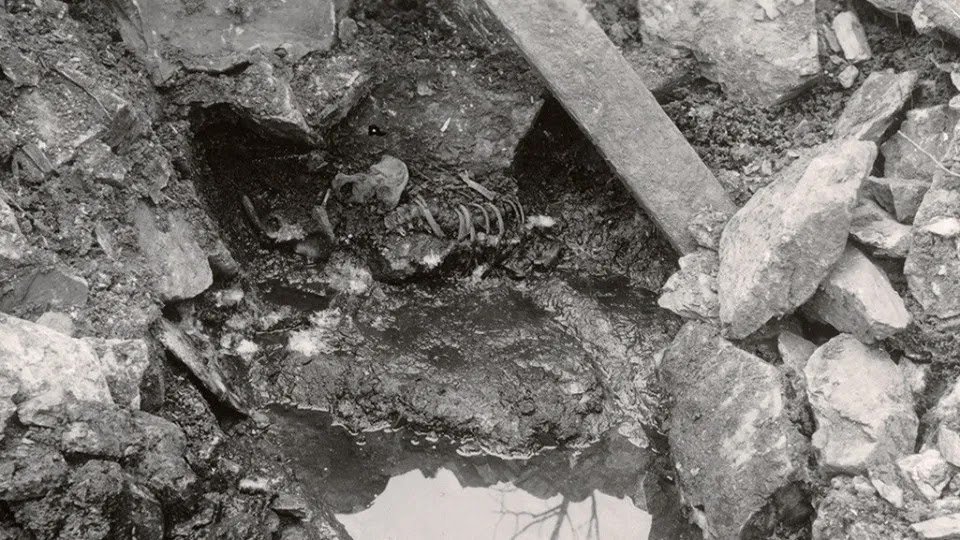

Legend has it that, in 1197, a body was thrown into a well by the besiegers of Sverresborg Castle, on the outskirts of Nidaros, currently the city of Trondheim, in central Norway. After all, the story may have a grain of truth.
The remains of a man whose death was recorded in a Norse text more than 800 years old may have been discovered by a team of archaeologists from the Norwegian University of Science and Technology.
Legend has it that, in 1197, a body was thrown into a well by the besiegers of Sverresborg Castle, on the outskirts of Nidaros, currently the city of Trondheim, in central Norway. The Sverris Saga chronicles the life of Norwegian king Sverre Sigurdsson, who rose to power in the late 12th century, a period of political instability and civil war that lasted decades after his death in 1202.
“We can never be 100% certain that the remains in the well are those of the man described in the saga, but the circumstantial and scientific evidence is very convincing. In a hypothetical trial, if a jury were confronted with the scientific evidence and the text of the saga, I know they would be convinced that we found the victim”, pointed out the co-author of the study published in November in the magazine iScience, Michael Martin, from the University Norwegian Science and Technology Board.
One of the passages in the 182-line saga, said to have been written by an Icelandic abbot close to the king, describes how, in 1197, Sverre Sigurdsson’s Catholic enemies sacked the fortress at Sverresborg while the monarch was in Bergen. The attackers entered the castle through a secret door while the watchmen, known as Birkebeiner, were eating.
“They took all the goods that were in the castle and then burned all the houses. […] They picked up a dead man and threw him head first into the well. Then, they piled stones until the well was full”, says the saga.
If the incident had actually happened, historians assume that the victim would have been a Birkebeiner and that the Baglers, as the attackers were known, intended to humiliate the king by contaminating the well water in a primitive form of biological warfare.
In 1938, archaeologists found, about seven meters deep and buried under several layers of stones, a human skeleton. With the outbreak of World War II, the German army occupied the area and the “well man” stayed where he was.
In 2014 and 2016, a team led by archaeologist Anna Petersén resumed excavation and, under piles of rubbish left there by Nazi forces, partially exhumed the remains of a man aged between 30 and 40. The victim was approximately 1.75 meters tall and was thrown into the well with a leather shoe on. He was missing a foot, nor a left arm, and the skull, which was separated from the body, sustained injuries caused by a blunt objective and several cuts, probably inflicted before death.
Through radiocarbon dating of the skeleton, scholars discovered that the man had “a conventional age of 940 years,” consistent with the date of the Baglers’ attack on Sverrisborg Castle as described in the Sverris Saga.
As the man’s DNA genome had not been adequately preserved, Martin Ellegard obtained a DNA sample from one of the victim’s teeth, analysis of which found that the individual had blond or light brown hair and blue eyes. Comparison of his genome with that of modern Norwegians indicated that the man was from southern Norway. This fact came as a surprise, as Sverre’s men were from central Norway. That means the Baglers may have thrown one of their own into the well.
“We showed that the sagas are not entirely fiction, which was perhaps a feeling shared by the public, although certainly not by historians. And I think this will help people better appreciate the content of the sagas”, he said.




Leave a Reply