
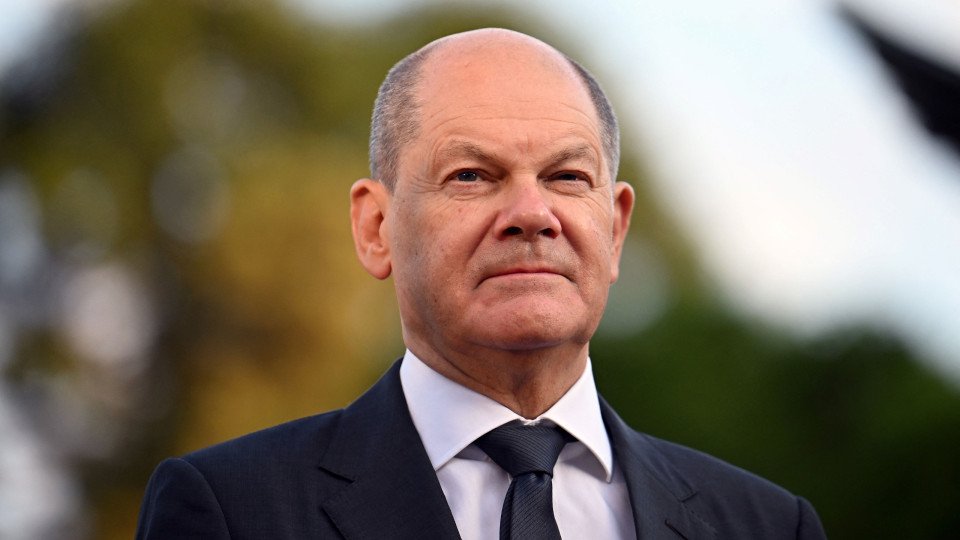

German Chancellor Olaf Scholz today labelled the knife attack in Solingen, which killed three people on Friday, ‘terrorism against all’ and called for better controls on arms possession and immigration.
‘It was terrorism, terrorism against all of us,’ said the German Chancellor during a visit to the western German city, expressing his “anger” at “the Islamists who threaten the peaceful coexistence of all of us”.
A 26-year-old Syrian national, the alleged perpetrator of the attack, handed himself in to police on Saturday night for murder and attempted murder, while the radical organisation Islamic State (IS) claimed responsibility for the crime.
‘I feel anger, my anger is directed at the Islamists. They have to know that we will not stop pursuing them,’ Scholz said in a speech alongside the leader of the executive of the federal state of North Rhine-Westphalia, Hendrik Wüst, and the mayor of Solingen, Tim Kurzbach.
Scholz spoke of the need to speed up the expulsion of foreigners who have no right to stay in Germany and to achieve better control of migration.
The German chancellor also wants stricter ‘arms regulations’, particularly regarding the carrying of knives, warning that ‘this has to be done very quickly’.
At the beginning of the month, Interior Minister Nancy Faeser proposed that only knives with blades up to 6 centimetres could be carried in public, instead of the 12 centimetres currently allowed.
The attack took place during a festival marking the city’s 650th anniversary, and eight people were injured.
Federal prosecutors said on Sunday that the suspect shared the radical ideology of the Islamic State group, which he joined at an unclear time, and that he was acting on those beliefs when he stabbed his victims repeatedly from behind in the neck and upper body.
The 26-year-old’s asylum application was rejected and he should have been deported last year to Bulgaria, where he entered the European Union (EU) for the first time, but the deportation failed because he disappeared for some time, according to the German press.
This has revived criticism of the government on migration and deportation, an issue in which it has long been vulnerable.
The government has taken steps to defuse the issue, for example with legislation to facilitate the deportations of unsuccessful asylum seekers, passed by lawmakers in January. It has also launched legislation to make it easier to deport foreigners who publicly approve of terrorist acts.
‘We have to do everything in our power to make sure that this kind of thing never happens in our country, if possible,’ Scholz said of the attack.
‘We will have to do everything we can to ensure that those who are not authorised to stay in Germany are sent back and deported,’ he said, adding that ’we have greatly expanded the possibilities for carrying out these deportations.’
Scholz said that there had already been a 30 per cent increase in deportations this year, but said that the executive would ‘carefully analyse’ a way to ‘increase these figures even further’.
The Chancellor said that control measures on Germany’s eastern borders have reduced the number of immigrants arriving ‘irregularly’, but that there is also room for improvement. Scholz spoke alongside Hendrik Wüst, governor of North Rhine-Westphalia and a member of Germany’s conservative opposition, which has long criticized the government on migration.
Wüst was ‘grateful’ for the announcement of more measures, but emphasised that ‘announcements alone will not be enough’ and ‘action must follow’.
The leader of the opposition, Friedrich Merz of Wüst’s Christian Democratic Union, warned on Sunday evening that ‘we have to do something together’.
‘We have people in Germany that we don’t want to have here and we have to make sure that more don’t come,’ said Merz, arguing that these migrants should be turned back at the country’s borders.
The far-right Alternative for Germany (AfD) party is also trying to capitalise on the attack in Solingen ahead of next Sunday’s regional elections in the eastern German states of Thuringia and Saxony.
‘Höcke or Solingen’ is the slogan launched by the AfD after the attack, alluding to the party’s leader in Thuringia, Björn Höcke, who is also the head of the most radical wing of the political force.
The AfD, which emerged as a Eurosceptic party and later became an Islamophobic and xenophobic grouping, began to grow on the German political scene after the 2016 migration crisis.



Leave a Reply