
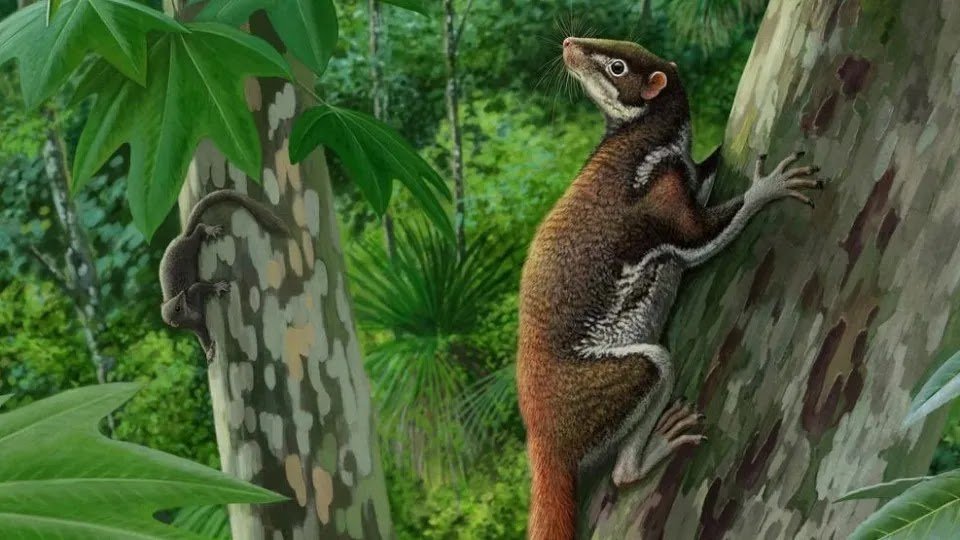

For more than 140 years, Mixodectes pungens, which inhabited western North America in the early Paleocene, remained a mystery.
The little that was known about this species was obtained mainly through the analysis of fossilized teeth and jaw fragments.
The study shows that Mixodectes adults weighed about 1.3 kilograms, lived in trees and fed mainly on leaves, the Europa Press agency reported on Tuesday.
It also shows that these arboreal mammals (an extinct family known as myxodectids) and humans occupy relatively close branches on the evolutionary tree.
“A 62-million-year-old skeleton of this quality and integrity offers new insights into myxodectids, including a much clearer picture of their evolutionary relationships,” study co-author Eric Sargis, a professor of anthropology at the Yale School of Arts and Sciences, said in a statement.
“Our findings show that they are closely related to primates and colugos (flying lemurs native to Southeast Asia), making them quite closely related to humans,” he added.
The study was published Tuesday in the journal Scientific Reports. Stephen Chester, associate professor of anthropology at Brooklyn College, City University of New York, is the lead author.
The skeleton was collected in the San Juan Basin, New Mexico, by co-author Thomas Williamson, curator of paleontology at the New Mexico Museum of Natural History and Science, under permission from the federal Bureau of Land Management. Includes a partial skull with teeth, spine, rib cage, forelimbs and hind limbs.
Researchers determined that the skeleton belonged to an adult, weighing about 3 pounds. The anatomy of the animal’s limbs and claws indicate that it was arboreal and capable of clinging vertically to tree trunks and branches. Its molars had grooves for breaking up abrasive material, suggesting it was omnivorous and ate mainly leaves, the study says.
“This fossil skeleton provides new evidence for how placental mammals diversified ecologically after the extinction of the dinosaurs,” said Chester, affiliate curator of vertebrate paleontology at Yale’s Peabody Museum.
“Traits such as greater body mass and greater reliance on leaves allowed Myxodectes to thrive in the same trees it likely shared with other early primate relatives,” he noted.
The researchers noted that Myxodectes was quite large for an arboreal mammal in North America during the early Paleocene, the geological epoch that followed the Cretaceous-Paleogene extinction event that wiped out non-avian dinosaurs 66 million years ago.
For example, the skeleton of Myxodectes is significantly larger than a partial skeleton of Torrejonia wilsoni, a small arboreal mammal from an extinct group of primates called plesiadapiforms, that was discovered nearby.




Leave a Reply